
Running a Sex Offender Check in Catron County
The primary public channel is the New Mexico DPS Sex Offender Registry, also known as OffenderWatch. The New Mexico Department of Public Safety Law Enforcement Records Bureau manages the statewide system. County sheriffs collect and update registration data, and the public website displays the portion that New Mexico law allows to be released. In Catron County, that local role belongs to the Catron County Sheriff's Office. Start with the state registry's county and address tools, not a broad web search. Official records distinguish a valid public registry disclosure from copied data that may be old.
Use more than a name when possible. Catron County spans a vast rural area, and many residents live outside Reserve in unincorporated communities such as Quemado, Datil, Glenwood, Pie Town, Luna, Aragon, and Apache Creek. A county filter can find entries that a city-only search misses. An address and radius search adds a second view when the live registry accepts the location. Search settings should be noted with the date because sheriff updates can change the public result.
Catron County Offender Registration Office
The Catron County Sheriff's Office is the local registration and compliance contact. Its office is at 100 Main, Reserve, NM 87830, and the main line is 575-533-6222. No official source published registration hours or an appointment policy, so call before making a long trip. The sheriff enters or updates the local registration, while the DPS Sex Offender Registration Unit handles the statewide database, the translation of convictions from other jurisdictions, and the public registry.
A person moving into New Mexico should contact the sheriff and confirm the documents needed. DPS advises an incoming registrant to bring the Judgment and Sentence and the Police Report. Questions about how an out-of-state, tribal, federal, military, or foreign conviction translates under New Mexico rules belong with the DPS unit at 505-476-2444 or dps.sorna@dps.nm.gov. A public searcher should also call the sheriff when a Catron County address or compliance status appears wrong, rather than trying to resolve it in public.
Catron County Sheriff's Office
100 Main
Reserve, NM 87830
575-533-6222
Call to confirm registration appointments and document requirements.
Searching the New Mexico DPS Sex Offender Registry / OffenderWatch
Open the registry from the official DPS Law Enforcement Records Bureau page. Vendor screens can change, but New Mexico's public framework supports name and geographic searches, map or list results, and email notification enrollment. A precise search can begin with an address, a Catron County filter, or a legitimately known name. Use the textual entry along with the map because rural geocoding may place a pin only near the reported location.
The official DPS records bureau page shown below is the state entry point for registry and repository services.
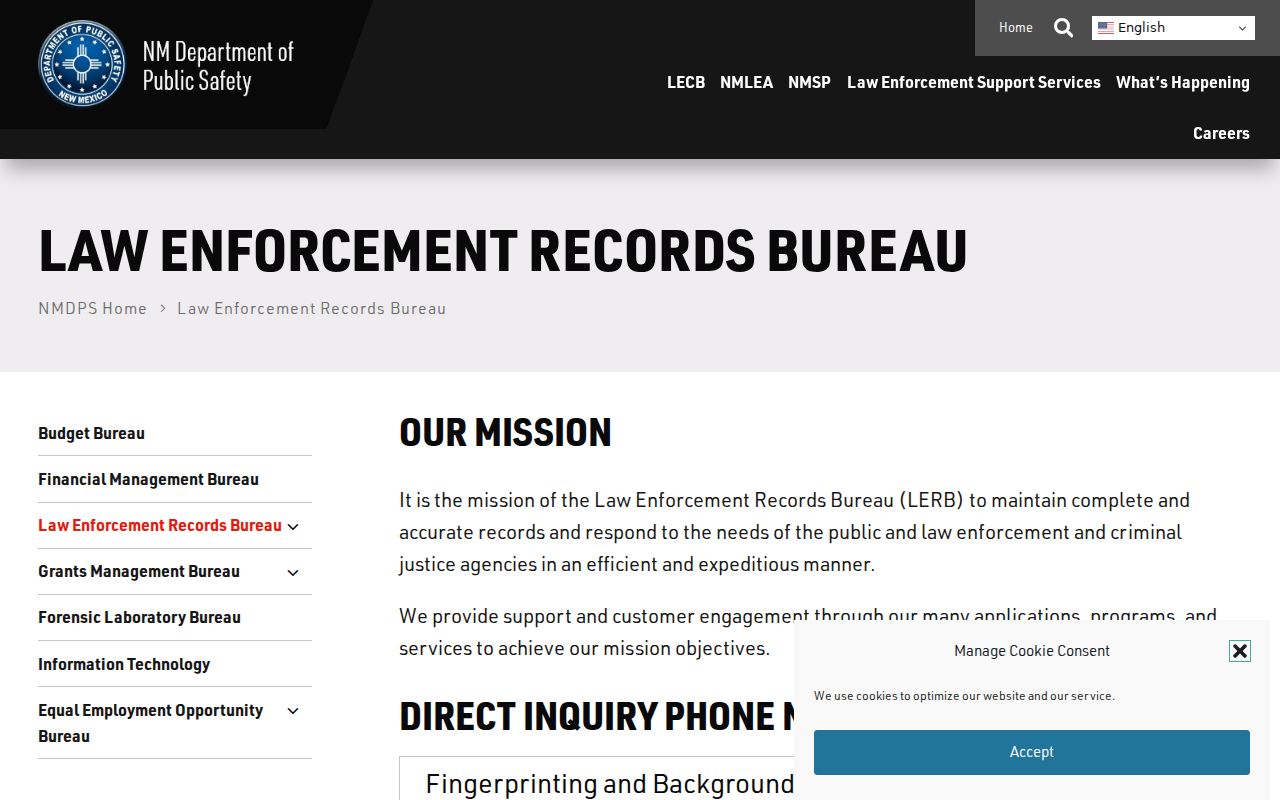
Following the state source helps avoid stale copies and directs questions to the agency that manages public registry data.
- Open the DPS registry link and read the current conditions of use.
- Select Catron County or enter a Catron address, city, ZIP code, or known name.
- Compare list and map results, then match aliases and physical details with care.
- Open the public profile, review the offense and status fields, and note the search date.
| Field Label | Type | Required | Notes |
|---|---|---|---|
| Last Name | Text | Mode dependent | Starts a name search |
| First Name | Text | No | Narrows a name result |
| Address | Text | Address mode | Sets the proximity-search origin |
| City or ZIP Code | Text or dropdown | No | Use Reserve or the relevant Catron area |
| County | Dropdown | No | Select Catron for countywide results |
| Radius | Dropdown | Address mode | Use only the distances offered live |
| Map or List | View control | No | Changes how results are displayed |
Missing Catron County Registry Results
A blank search is not a clean-history certificate. DPS states that some people are not required to register, while some registered people fall into non-releasable classifications and do not appear on the public site. Spelling, aliases, rural route formats, ZIP boundaries, and map placement can also change a search result. Run a Catron County search in addition to a Reserve search, then try an address radius and a known name where lawful and relevant.
For a suspected omission, do not publish an accusation. Call the Catron County Sheriff's Office or the DPS SOR Unit. Officials can determine whether the person is subject to registration, whether the data is non-releasable, or whether an update needs review. New Mexico law, including NMSA 1978 §29-11A-5.1 and related Sex Offender Registration and Notification Act provisions, controls what registration information the public may see.
Note: Public visibility is narrower than the full set of registration duties, so an absent name does not settle legal status.
What a Registry Profile Shows
A public profile is meant to help identify a registrant and understand the disclosed registration basis. It may show a name, aliases, photograph, physical traits, an address or location allowed by law, qualifying conviction information, and a current administrative status. Some profiles may also include vehicle, work, school, or distinguishing-mark details when those fields are publishable and have been entered. Each field needs context. A dated photograph may not match current appearance, and an approximate map pin is not better evidence than the text entry.
| Name & Aliases | Identity labels used for matching; an alias is not a separate person by itself. |
|---|---|
| Photo & Description | Identification aids such as sex, race, height, hair, and other physical descriptors that can change. |
| Registered Location | The address or location New Mexico law permits the public system to release. |
| Offense & Jurisdiction | The qualifying conviction, statute, date, and jurisdiction when published. |
| Classification | The administrative registration cycle and whether the information is publicly releasable. |
| Compliance Status | A time-sensitive field that should be confirmed with law enforcement if a problem is suspected. |
The profile does not replace a court file, a full arrest history, or a current supervision record. It focuses on the qualifying offense and registration duty. It may omit other cases, arrests, court events, or special probation conditions. For wider county record context, use the Catron County criminal history overview and the official custodian for the record at issue.
Catron County Cross-State Registry Search
Catron County lies near Arizona and contains remote communities where daily routes may cross county or state lines. The National Sex Offender Public Website provides the official federal search layer across participating jurisdictions. Use it when the relevant person or address may connect to another state, tribal area, or county. NSOPW does not erase differences in each jurisdiction's release rules, so open the source profile and read the local terms attached to the result.
The official NSOPW interface pictured below is useful after a New Mexico county and radius search.
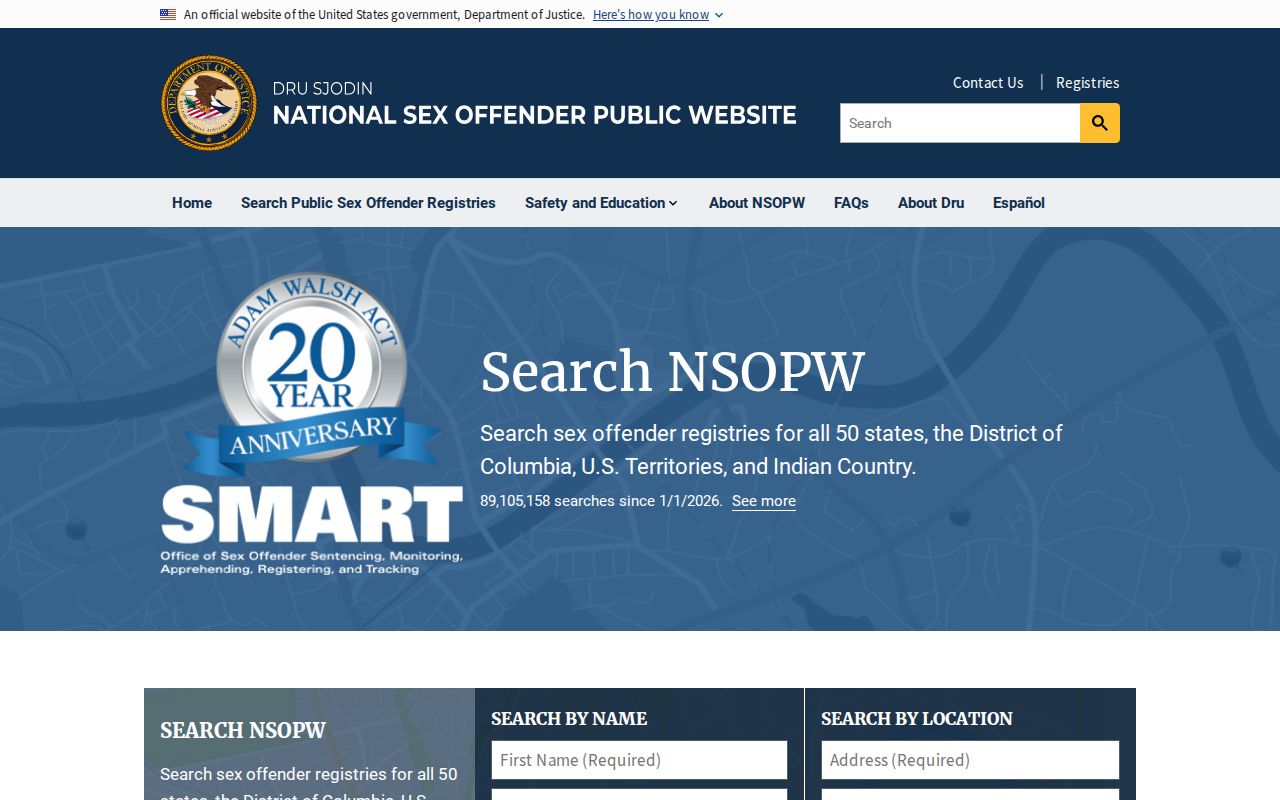
Using both official layers is especially helpful when a Catron County location is close to a jurisdiction boundary.
Keep the searches distinct. OffenderWatch is the New Mexico source, with Catron registrations entered by the sheriff. NSOPW searches public records from participating jurisdictions. Neither tool guarantees a person's present physical location at the instant of a search, and neither should be treated as a full criminal record.
Registration Requirements and Levels in New Mexico
New Mexico DPS uses five administrative classifications, not a simple public Tier I, Tier II, and Tier III chart. The labels describe registration cycles and public release status. Exact duration depends on the offense, conviction date, and the rules in NMSA Chapter 29, Article 11A and 10.2.3 NMAC. A person-specific legal answer requires the governing statute and record, so the categories should not be converted into federal SORNA tiers.
| DPS Classification | Verification Frequency | Duration | Public Visibility |
|---|---|---|---|
| 90 Day Re-Registrants | Every 90 days | Offense and date specific | Released when governing law permits |
| 90 Day Non-Releasable | Every 90 days | Offense and date specific | Not publicly releasable under the applicable rule |
| Annual Registrants | Annual | Offense and date specific | Released when governing law permits |
| Annual Non-Releasable | Annual | Offense and date specific | Not publicly releasable |
| Semi-Annual Non-Releasable | Twice each year | Offense and date specific | Not publicly releasable |
DPS notes that New Mexico law can apply to a person convicted, incarcerated, or on probation or parole as of July 1, 1995. Visitor rules also depend on the conviction date. DPS describes a presence threshold of more than 14 days, or over 30 days in a calendar year in total, for certain pre-July 2013 convictions. For convictions after July 1, 2013, DPS states that registration is due within five days. Confirm the current law with DPS for any real deadline.
Catron County Registry and Residency Rules
New Mexico DPS says the state has no statewide residential-distance restriction for registered sex offenders. That fact is easy to confuse with supervision conditions. A court or probation and parole officer may impose a person-specific rule about proximity to schools, day care sites, or other places. Such a condition is not the same as a statewide ban that applies to every registrant.
When a concern involves current probation or parole, the official supervision channel is the New Mexico Corrections Department. NMCD Offender Search covers state prisoners and people under NMCD probation or parole supervision. Catron County is assigned to Region III, and the probation and parole verification line is 866-416-9867. The locator does not show a full supervision file, and detailed case records may be confidential. It can still help confirm whether a publishable state supervision record exists.
Note: A registry duty, a public profile, and a supervision condition are separate facts that may have different sources and update times.
Catron County Offender Email Alerts
New Mexico's registry framework offers email notifications when an offender moves into a selected area. The live OffenderWatch interface should be used to set the address and area it currently accepts. Alerts are useful in Catron County because a resident may care about a rural address outside Reserve, not just a village name. They report qualifying registry updates within the subscribed geography. They are not continuous tracking and do not prove where a person is at every moment.
No verified Catron County Sheriff mobile app, Reserve police app, local registry app, or public community-meeting schedule was found in official sources. The documented public notification route is the registry's email signup. If an alert seems inconsistent with a profile, compare the text address and update status, then ask CCSO or DPS to verify. Do not rely on a map pin alone in a county where rural geocoding can be approximate.
Lawful Use and Community Notification
Registry information supports personal, family, and community safety. It does not authorize confrontation, trespass, threats, harassment, vigilantism, or unlawful discrimination. Suspected noncompliance should be reported to the Catron County Sheriff's Office or the DPS Sex Offender Registration Unit at 505-476-2444 or dps.sorna@dps.nm.gov. When a concern involves a special probation or parole condition, contact the NMCD supervision office as well.
Misuse is unlawful: Threatening, harassing, or intimidating a registrant or household with registry information can be a crime. New Mexico registry publication and duties are governed by NMSA 1978 Chapter 29, Article 11A and 10.2.3 NMAC.
A perceived mismatch should go to officials, not social media. Provide the profile, address, search date, and the exact issue. The sheriff can review local registration data, while DPS can address public-site publication and conviction-translation questions. This route protects safety without turning an uncertain map result or omitted field into an unsupported claim.